XRechnung for US companies: what German customers may ask for
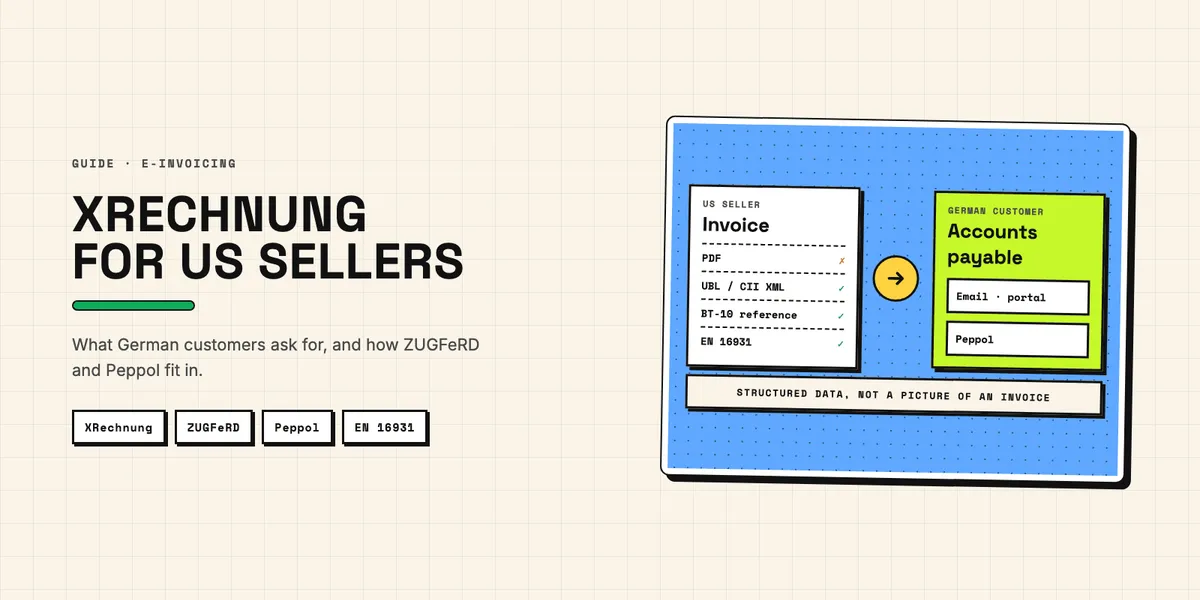
XRechnung is Germany's standard for electronic invoices: a pure XML file, without a PDF, that follows the European e-invoicing standard EN 16931 plus a set of German rules. A US company without an establishment in Germany is not legally required to send XRechnung to German business customers. It does have to send XRechnung, or another EN 16931 format, to German federal agencies, and German customers may ask for it because their own accounting is moving to structured invoices.
This guide explains when XRechnung is required, what a German customer may want in it, how it relates to ZUGFeRD and Peppol, and how a US billing stack can produce it. It is written for US software and service companies selling into Germany, including teams whose invoice data starts in a CRM; our overview of what you can build on the Pipedrive API explains what an integration that reads deal data can do and what each request costs. Everything below was checked against German law, the federal tax ministry and the standards bodies on October 2, 2026. It is general information, not tax advice, and quotes from German-language sources are our translation.
What is XRechnung?
XRechnung is the German core invoice usage specification, or CIUS, of the European standard EN 16931. It takes the European invoice data model, makes some optional fields mandatory and adds German business rules. It is maintained by KoSIT, the coordination office for IT standards of the German federal and state governments.
An XRechnung file uses one of the two XML syntaxes the European standard allows, UBL or UN/CEFACT CII. There is no visual layer: the tax ministry's FAQ points out that, unlike ZUGFeRD, XRechnung carries no additional PDF representation of the invoice. Your customer's accounting system reads the data, and a person who wants to look at the invoice needs a viewer.
According to KoSIT's versions page (in German), the current version is XRechnung 3.0, specification 3.0.2, which stays in force until at least July 31, 2027. A draft of XRechnung 4.0, dated September 15, 2026, was published in September, and the final version is expected in spring 2027. KoSIT publishes the specification itself in German, with an English summary, while the documentation of its technical components, such as the validator, is in English.
Do US companies have to send XRechnung to German businesses?
No, as long as your company has no registered seat or management in Germany and no German permanent establishment that is involved in the sale. The German mandate applies only when both seller and buyer are established in Germany. Section 14 of the German VAT Act (in German) requires an e-invoice when supplier and recipient are both established there, and the tax ministry's guidance states that there is no obligation if at least one of them is not.
In that case the invoice can go out on paper or, with the customer's consent, electronically: as an XRechnung, a PDF or any other format you agree on. A German VAT registration alone does not change this. The tax ministry's e-invoicing FAQ (in German) says foreign businesses registered for VAT in Germany without a fixed establishment there can state this in their invoice to explain why they do not issue an e-invoice, and a customer acting with ordinary business care may rely on that statement.
A German subsidiary is a different case. A GmbH, a German limited liability company, has its seat in Germany, so its invoices to German businesses fall under the mandate. Receiving e-invoices has been mandatory since January 1, 2025. Sending them becomes mandatory on January 1, 2027, for companies with more than €800,000 in revenue in the previous year, and on January 1, 2028, for everyone else. EDI exchanges, meaning direct data exchange between company systems, may continue until the end of 2027. Small businesses under the German small-business rule do not have to issue e-invoices, and invoices up to €250 gross can still go out on paper or as a PDF. A subsidiary above the €800,000 threshold in 2026 has less than three months left to get its invoicing ready.
What changes with reverse charge?
Nothing about the e-invoice question. When a US company provides services to a German business, the place of supply is usually Germany, and the German customer owes the VAT under the reverse-charge rules of section 13b of the VAT Act. You still issue the invoice, without German VAT and with a note that the customer is liable for the tax.
Section 14a(5) of the VAT Act requires the wording "Steuerschuldnerschaft des Leistungsempfängers", meaning that the recipient is liable for the tax. The German VAT administrative guidelines also accept wording used in other official EU languages, which explicitly includes the English "Reverse charge". The tax ministry's 2025 guidance is explicit that reverse-charge invoices fall under the e-invoicing mandate only when both parties are established in Germany, so a US seller without a German establishment has no obligation here either.
If you do send an XRechnung for a reverse-charge supply, the line items use VAT category code AE. The rules then require a seller tax identifier (field BT-31, BT-32 or, if a German tax representative acts for you, BT-63) and the customer's VAT ID (BT-48) or legal registration identifier (BT-47), such as a commercial register number, and the reverse-charge note goes into BT-120 or, as code VATEX-EU-AE, into BT-121. If you have no German or EU VAT number, agree with the customer and your tax advisor what goes into BT-32.
When is XRechnung mandatory for a foreign supplier?
When you invoice the German federal government, and possibly a state or municipal agency, depending on that state's rules. The federal E-Invoicing Ordinance (in German) applies to every supplier, and the federal e-invoicing service says so directly in its FAQ for suppliers: "If the invoice issuer is a foreign company, that company is also obliged to submit electronic invoices to the German federal administration." Direct orders up to €1,000 are exempt.
The ordinance names XRechnung as the default and allows another standard if it meets EN 16931. On top of the usual invoice content, a federal invoice must carry the agency's Leitweg-ID, your bank details, payment terms and your email address; a supplier number and an order number are mandatory too if the agency gave them to you. The Leitweg-ID is the agency's routing ID. It goes into field BT-10, "Buyer reference", and the agency gives it to you when it places the order.
Since September 19, 2025, most federal agencies receive e-invoices through a single portal, OZG-RE; the older ZRE portal was switched off. OZG-RE accepts invoices through a web form, upload, email or Peppol, and every channel requires a free OZG-RE account first. The web form is available in English, which helps a supplier without e-invoicing software. Germany's 16 states and their municipalities set their own rules, including whether and how a Leitweg-ID is issued, so check the purchase order for instructions.
Why would German customers ask for XRechnung anyway?
Because they have had to be able to receive e-invoices since January 2025, and their accounts payable teams are moving to structured data. For them, a PDF increasingly means manual entry. Asking for an e-invoice is still a request, not a legal demand: for a foreign seller, format and channel are a matter of agreement with the customer.
When a German customer asks, expect questions about a handful of fields. In XRechnung the buyer reference is always mandatory, but for business customers it does not have to be a Leitweg-ID. KoSIT says recipients can give suppliers "an identifier of their choice". The tax ministry's FAQ gives a supplier number as an example and even calls a placeholder such as "-" sufficient for VAT purposes in B2B. The German rules also make seller contact details, including phone and email, mandatory. XRechnung also requires an electronic address for both sides (fields BT-34 and BT-49), usually an email address or a Peppol ID, so ask the customer which one to use. If you mark the payment as a SEPA transfer (code 58), the euro bank transfer scheme, the validator warns if no valid IBAN, the international bank account number, is given; a regular transfer (code 30) to a US account is not checked for one.
| Request | What it means for your invoice |
|---|---|
| Buyer reference or Leitweg-ID | field BT-10; mandatory in every XRechnung |
| Purchase order or supplier number | reference fields; mandatory for federal agencies if provided |
| Customer VAT ID or registration identifier | needed in an XRechnung with reverse charge (BT-48 or BT-47) |
| Buyer electronic address | email address or Peppol ID for field BT-49 |
| Format and delivery channel | XRechnung or ZUGFeRD, by email, portal or Peppol |
| Note on establishment | if you are VAT-registered in Germany: why you are not required to issue an e-invoice |
XRechnung, ZUGFeRD or Peppol: what is the difference?
XRechnung and ZUGFeRD are invoice formats; Peppol is a delivery network with its own format. All three build on EN 16931, so they are related, but they solve different problems. For a US seller the practical question is which one a given customer can process and how it should reach them.
ZUGFeRD (in German) is a hybrid: a PDF/A-3 document with the structured XML embedded in it. The customer can open it like any PDF, and the accounting system reads the XML. The current version is 2.5.2 from August 2026; Factur-X is the French name for the same format. Since version 2.0.1, ZUGFeRD counts as an e-invoice in Germany, except for the MINIMUM and BASIC-WL profiles, which carry too little data. For federal agencies, the e-invoicing service names ZUGFeRD in its XRechnung profile, as a pure XML file without the PDF, as an accepted alternative.
Peppol is an international network in which certified service providers, called access points, pass invoices between companies. Its invoice format, Peppol BIS Billing 3.0, is also a CIUS of EN 16931 and uses UBL as its mandatory syntax; CII is optional for receivers who register for it. XRechnung 3.0 and Peppol BIS were harmonized, and an XRechnung file can travel through Peppol unchanged, as long as the receiver is registered to receive XRechnung documents. They are siblings, not twins: XRechnung has extra German rules, so not every Peppol invoice is a valid XRechnung. Peppol is not mandatory for German business-to-business invoices, because the law does not prescribe a channel and an email inbox is enough.
Can your US billing tool produce XRechnung?
Not out of the box, in the tools we checked. When we went through the vendors' own material for Stripe, NetSuite, Xero and QuickBooks Online on October 2, 2026, none of the four documented a built-in way for a US company to send an XRechnung. That makes the format a build-or-buy decision once a customer insists on it; for occasional federal invoices, the free OZG-RE web form needs no software at all.
Stripe's e-invoicing documentation says Stripe Invoicing "doesn't generate or transmit legally compliant e-invoice files on its own" and points to third-party apps or a custom webhook integration. Oracle documents NetSuite's German e-invoicing support as receiving XRechnung vendor bills, not sending invoices. According to staff posts in Xero's product ideas portal, Xero added Peppol e-invoicing for organizations in Germany and other EU countries in December 2025, while sending e-invoices from a US Xero organization is still listed as an idea. We found no Intuit documentation on XRechnung or ZUGFeRD for QuickBooks Online; our article on the QuickBooks API covers what it does offer. Pipedrive's invoicing feature does not create e-invoices either; it hands deal data to a connected invoicing app, and our guide to Pipedrive apps and add-ons explains how to judge such an app before installing it.
If you build it yourself, the data usually starts in your CRM or billing system, and open-source libraries handle the format. Mustang (Java, Apache 2.0) creates and validates ZUGFeRD, Factur-X and XRechnung. For PHP, the maintainer of the widely used horstoeko/zugferd library recommends its successor, invoicesuite, for new projects, and in Python the factur-x package builds Factur-X PDFs. Whatever you use, run the output through KoSIT's free validator with the XRechnung configuration before the first invoice goes out. Our own Pipedrive plugin for e-invoices, E-Rechnung Export, is announced for the fourth quarter of 2026 and not available as of October 2.
What changes in 2030?
E-invoicing becomes the rule for cross-border business within the EU. The EU's VAT in the Digital Age package, Directive (EU) 2025/516, requires EN 16931 e-invoices and transaction-level reporting for business-to-business supplies between member states. According to the European Commission's overview, these digital reporting requirements "will affect cross-border B2B transactions from 1 July 2030". The directive places the reporting duty on every "taxable person identified for VAT purposes" in the EU.
For a US company that sells from the US without an EU VAT registration, the answer is not settled yet. The directive also covers purchases on which the customer owes the VAT, which includes reverse-charge purchases from you, but it lets member states waive that part. Whether your German customer must report its purchases from you, and whether your invoices then have to be e-invoices, depends on how Germany implements the directive. According to the tax ministry's FAQ, the federal government will propose the legal changes for its planned reporting system in due course.
If your company has an EU subsidiary or an EU VAT identification, its cross-border EU sales will fall under the new rules directly. We expect structured invoices to become the norm for German customers by 2030, but for a US seller without EU registration that is our assessment, not a legal requirement today. If you want to plan the invoicing side of your German business now, you can get in touch with us.
Frequently asked questions
Is XRechnung the same as an EU e-invoice? It is the German version of one. XRechnung is a national specification of the European standard EN 16931, with extra German rules such as the mandatory buyer reference. Every valid XRechnung meets EN 16931, but not every EN 16931 invoice is a valid XRechnung.
Can I send a ZUGFeRD PDF instead of XRechnung? To German businesses, yes, if they agree; ZUGFeRD from version 2.0.1 counts as an e-invoice except for the MINIMUM and BASIC-WL profiles. For federal agencies, the e-invoicing service names ZUGFeRD in its XRechnung profile, as a pure XML file without the PDF, as an accepted alternative.
What is a Leitweg-ID? The routing ID of a German public agency. It goes into the buyer reference field BT-10, and the agency gives it to you with the order. Business customers do not have a Leitweg-ID, but they can ask you to put their own reference into the same field.
Do I need to join Peppol to sell to German companies? No. Germany does not prescribe a delivery channel for business invoices, and email works. Peppol becomes useful when a customer or a federal agency prefers it, or when you invoice several EU countries that use it.
How can I check that my XRechnung is valid? Run the file through KoSIT's open-source validator with the XRechnung configuration. It checks the XML schema and the German business rules and reports errors, such as a missing buyer reference, as well as warnings for rules that are recommendations rather than requirements.